

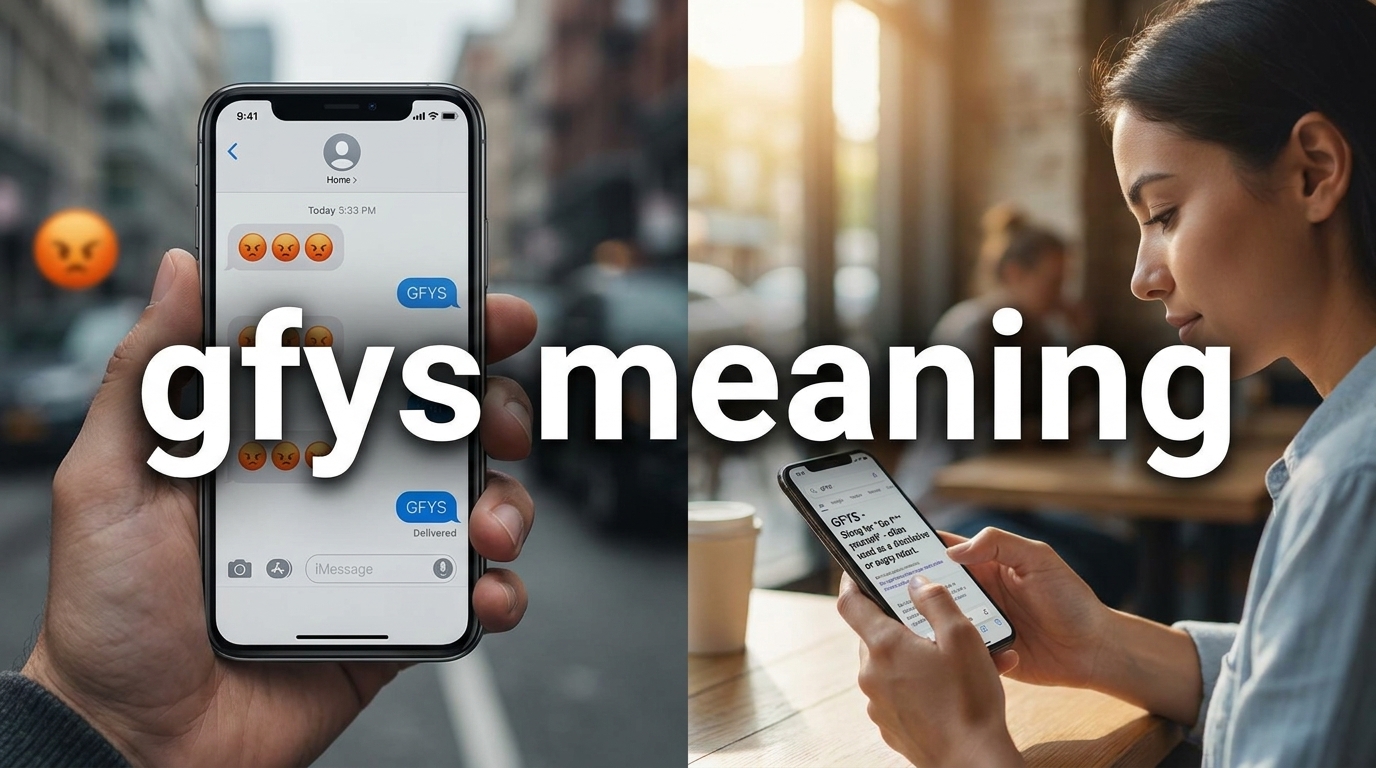
Ever received a text that simply says “GFYS” and wondered what it means? This short acronym can feel confusing, especially when you can’t hear the sender’s tone.
The gfys meaning is usually “Go F* Yourself.”** It’s a blunt phrase that can express anger, frustration, dismissal, or sarcasm. In some friendships, though, people use it as playful teasing.
Context makes all the difference. The sender, your relationship, emojis, and the conversation before it can change how the message comes across.
In this guide, you’ll learn what GFYS means in text, where people use it, when it sounds rude, and what to say instead when you want to avoid unnecessary conflict.
Why Your Brain Just Hit the Brakes on This One
Seeing GFYS in a text can make you stop for a second. The acronym looks simple, yet its message carries serious emotional weight.
The gfys meaning is usually “Go F* Yourself.”** It tells someone to go away in a blunt and insulting way.
Still, context matters. A close friend might use it during playful teasing. A stranger may use it during a heated argument.
For example:
Friend: “I got the concert tickets before you!”
You: “GFYS 😂”
That exchange may sound playful because of the friendship context.
However, this would feel very different:
Stranger: “You have no idea what you’re talking about.”
Reply: “GFYS.”
Here, the acronym signals hostility and confrontation.
The key is to read the surrounding conversation before judging the intent.
Breaking Down What “GFYS” Actually Says
The basic GFYS acronym meaning comes from the phrase “Go F* Yourself.”** Each letter represents part of that expression.
- G = Go
- F = F***
- Y = Yourself
- S = Yourself’s final sound represented in the abbreviation
In everyday text slang, though, people rarely stop to analyze every letter. They recognize GFYS as an aggressive dismissal.
The phrase can communicate several ideas:
- “Leave me alone.”
- “Get lost.”
- “I’m done with you.”
- “I don’t want to hear this.”
- “I’m extremely angry.”
Its meaning becomes sharper when someone sends it alone.
Person A: “Can we talk about what happened?”
Person B: “GFYS.”
That response doesn’t invite discussion. It signals ending a conversation and often creates a clean break.
Unlike milder internet slang, GFYS carries unmistakable confrontational language.
Where This Acronym Shows Up in Your Daily Scroll
You’ll usually encounter GFYS where people communicate quickly and casually. That includes DMs, gaming chats, group texts, and social media arguments.
Gaming communities can add another layer. Players sometimes use GFYS as trash talk after losing a match or during a heated exchange.
You may also see it on:
- Reddit-style forums
- Instagram comments
- TikTok discussions
- Twitter conversations
- Private messages
- Group chats
- Online arguments
For example:
Player: “You only won because I lagged.”
Reply: “GFYS 😂”
That could be friendly banter between regular teammates.
On the other hand, strangers rarely share enough friendship context for the joke to land safely.
Anonymity can also make online arguments harsher. Someone behind a screen may use stronger language than they would face-to-face.
That makes digital communication etiquette especially important.
Read More: What Does TOTM Meaning :It’s Not What You’d Guess
Tone & Context: “GFYS Meaning Changes Depending on Who’s Typing
The gfys meaning doesn’t always change. The tone behind it can.
A close friend may use GFYS as exaggerated humor. Someone you’re arguing with may use the same letters as a direct insult.
Consider these factors:
- Who sent it?
- What happened before it?
- Was the conversation playful?
- Did someone cross a boundary?
- Were emojis involved?
- Is the relationship close or distant?
For example:
Friend: “I finished the game without you.”
You: “GFYS 😂”
The laughing emoji and friendship context may signal playful teasing.
Now compare that with:
Coworker: “Please explain why you missed the deadline.”
Reply: “GFYS.”
That message sounds hostile and could create serious professional problems.
Text lacks facial expressions and vocal cues. Emojis provide some digital body language, yet they can’t guarantee the intended tone.
Situations Where “GFYS” Will Absolutely Backfire on You
Some situations simply aren’t worth the risk. GFYS can turn a small disagreement into a much bigger problem.
Avoid using it with:
- Coworkers
- Managers
- Clients
- Family members during serious conflicts
- Strangers
- Professional groups
- People you barely know
Work Slack deserves special caution. A rude message can be saved, forwarded, or screenshotting messages can preserve it long after the argument ends.
A heated text can also create HR issues when coworkers become involved.
Dating relationships require similar care. Sending GFYS during an emotional disagreement can become a major red flag behavior.
Instead of burning the bridge, try a calmer response:
“I’m stepping away from this conversation.”
Or:
“Let’s drop it.”
Those phrases still establish a boundary without adding unnecessary aggression.
When emotions run high, waiting before replying can prevent a message you’ll regret later.
Saying What You Mean Without the “GFYS” Risk
You don’t need an insult to end an argument. Several polite shutdown phrases can communicate the same boundary without creating extra drama.
Try these depending on your situation:
- “Let’s agree to disagree.”
- “I’m stepping away from this conversation.”
- “Let’s drop it.”
- “I’d rather not discuss this anymore.”
- “I think we should leave it there.”
- “I’m not continuing this argument.”
For professional communication, choose especially neutral wording.
Coworker: “We need to settle this today.”
Reply: “I think we’ve reached an impasse. Let’s revisit it later.”
With close friends, you have more room for humor.
Friend: “I told you I was right!”
Reply: “Okay, okay. You win 😂”
These alternatives protect the message’s purpose without creating a toxic conversation.
Sometimes walking away says more than another angry acronym.
Real-Life Examples of Using GFYS Meaning in Action
The best way to understand gfys meaning is to see how context changes its impact.
Online argument
Person A: “Your opinion makes no sense.”
Person B: “GFYS.”
Here, GFYS sounds openly hostile.
Gaming chat
Player: “You got lucky that round.”
Player 2: “GFYS 😂”
Between friends, this could simply be trash talk.
Close friends
Friend: “I got the last slice.”
Reply: “GFYS 💀”
The exaggerated response may signal joking rather than genuine anger.
Dating relationship
Partner: “Can we talk about last night?”
Reply: “GFYS.”
That response sounds much more serious. It can indicate anger, avoidance, or a relationship red flag.
Stranger
Commenter: “Learn how to read.”
Reply: “GFYS.”
Without friendship context, most readers will interpret it as an insult.
Different Corners of the Internet Treat “GFYS” Differently
Internet culture doesn’t give every acronym the same social meaning. The platform, audience, and relationship can shape how GFYS lands.
In gaming chats, GFYS may appear during competitive trash talk. Reddit-style forums can also feature blunt exchanges because anonymity sometimes lowers social restraint.
Social media creates a different problem. A comment on Instagram, TikTok, or Twitter can become public very quickly.
Private DMs feel more personal. Group texts sit somewhere between private conversation and public performance.
Generational differences can matter too. Some teens and younger users may treat aggressive slang more casually. Older users may read the same phrase as a serious insult.
Still, assumptions can cause tone misinterpretation.
Friend: “GFYS 😂”
Stranger: “GFYS.”
The words match. The social meaning doesn’t necessarily feel the same.
Ways People Get “GFYS” Completely Wrong
GFYS creates confusion because people sometimes focus on the letters instead of the text message context.
One common mistake involves GFY. Depending on context, GFY can mean “Good For You.” Confusing it with GFYS can completely change the message.
Another mistake involves emojis. A laughing emoji doesn’t automatically make an insult friendly.
“GFYS 😂”
That could still feel aggressive if the conversation was already tense.
People also misread playful teasing vs. genuine anger. A close friend may exaggerate for comedy. A stranger usually doesn’t have that same cushion.
Overusing slang creates another problem. Constant aggressive abbreviations can become immaturity signals rather than clever jokes.
Finally, don’t assume GFYS means exactly the same thing everywhere. The relationship, platform, previous messages, and emotional tone all matter.
When uncertain, choose a neutral response instead of escalating the situation. Miscommunication can turn one tiny acronym into a full-blown argument.
Questions People Actually Ask About GFYS Meaning in Text
Is GFYS always rude?
Usually, GFYS meaning points to “Go F*** Yourself.” It sounds rude, dismissive, or openly hostile in most text message context.
Still, tone can change between close friends. Someone might use it as playful teasing after a silly comment.
- With strangers: Usually offensive
- With friends: Sometimes joking
- During an argument: Usually aggressive
- At work: Best avoided
Example:
Alex: “You lost the bet. Dinner’s on you.”
Sam: “GFYS 😂”
Here, the emoji and friendship context may soften the message.
Can girls use it differently than guys?
No fixed rule says women or men use GFYS differently. The meaning depends more on the relationship, situation, and tone in text messages.
Gender doesn’t create a separate acronym meaning. A close friend may use it jokingly, while a stranger could use the same letters aggressively.
What matters most is digital body language, such as emojis, punctuation, and previous messages.
Example:
Mia: “You actually believed that?”
Jen: “GFYS 😂”
The laughing emoji may suggest playful teasing rather than genuine anger.
What if someone sends GFYSB?
GFYSB can be understood as a variation of GFYS, often interpreted as “Go F*** Yourself, B****.” It carries a stronger insult than the basic acronym.
Because the added insult increases hostility, don’t assume it’s harmless slang. Context still matters.
- Argument: likely aggressive
- Gaming trash talk: possibly provocative
- Close friends: could be joking
- Unknown person: treat it seriously
If someone sends GFYSB during a heated exchange, continuing the argument may only make things worse.
Is there ever a polite version?
There isn’t a genuinely polite version of GFYS because its core phrase is insulting.
You can communicate the same basic idea without using confrontational language. Choose a phrase that matches what you actually want.
Try:
- “Let’s agree to disagree.”
- “Let’s drop it.”
- “I’m stepping away from this conversation.”
- “I’d rather not discuss this anymore.”
- “I don’t think this conversation is productive.”
These polite shutdown phrases protect the relationship instead of turning a disagreement into bridge-burning.
Should I respond if someone sends me this?
You don’t have to respond. Sometimes the smartest response is no response at all.
First, look at the text message context. A friend sending “GFYS 😂” may be joking. A stranger sending it after an argument may be trying to provoke you.
Consider:
- Who sent it?
- What happened before it?
- Does the message sound playful or hostile?
- Is this becoming a toxic conversation?
- Could responding make things worse?
If the message feels threatening or abusive, save the conversation before blocking someone.
Example:
Them: “GFYS.”
You: “I’m not interested in arguing. Take care.”
That ends the exchange without adding more fuel.
Does GFYS mean the same thing everywhere?
Not always. GFYS meaning can shift slightly depending on the platform, community, and relationship.
Gaming chats often use stronger trash talk. Reddit-style forums and social media arguments can also make blunt slang feel more normal.
However, internet culture doesn’t automatically make the phrase harmless.
You may see GFYS in:
- Gaming chats
- Group texts
- DMs
- TikTok
- Online arguments
- Friend conversations
Professional communication is different. Using it in Work Slack, especially toward coworkers, can create HR issues and even career consequences.
The safest approach is simple: read the room before using slang.
Last Thoughts on Keeping This Text Slang in Check
Understanding gfys meaning isn’t only about memorizing an acronym. You also need to understand the emotion behind it.
The same four letters can signal playful teasing, frustration, or outright hostility.
Before sending it, ask yourself:
- Could this sound aggressive?
- Does the relationship support this kind of joke?
- Could someone screenshot the message?
- Am I angry right now?
- Would a calmer phrase work better?
Remember that text removes facial expressions and voice tone. That makes tone misinterpretation surprisingly easy.
A joke between close friends can look completely different from a message sent to a coworker or stranger.
When in doubt, choose clarity over shock value. You can disagree, set boundaries, or end a conversation without turning a small conflict into a bigger one.
