

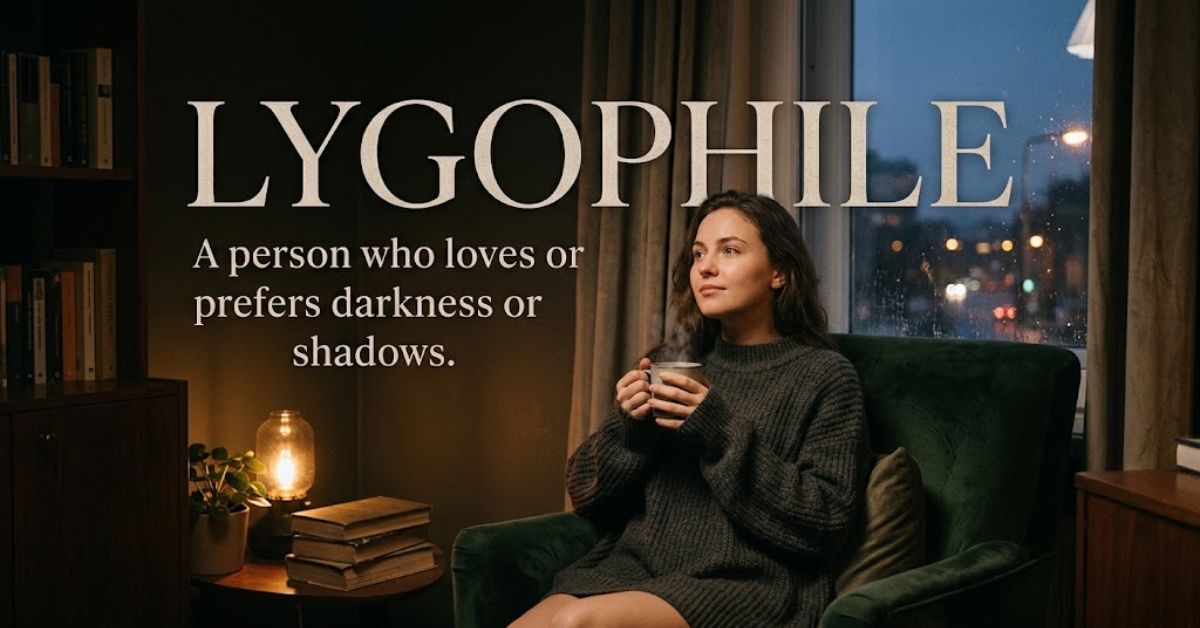
Do you feel more relaxed when the lights are dim and everything around you becomes quiet? Maybe you prefer candlelight over bright ceiling lights, enjoy sitting in a shadowy room, or love the peaceful atmosphere that arrives after sunset. If that sounds familiar, the word lygophile may describe you.
A lygophile is a person who enjoys darkness, dim lighting, shadows, or low-light surroundings. For some people, these environments create a sense of calm, privacy, comfort, or focus.
Being a lygophile doesn’t mean you hate sunlight or spend your entire life sitting in a dark room. It simply describes an attraction to darkness or softer lighting.
You might enjoy reading beside a small lamp, listening to music with the lights turned down, walking outside at dusk, or relaxing in a softly lit bedroom.
The key idea is a preference for darkness or low light, not necessarily a preference for staying awake all night.
What Does Lygophile Mean?
Lygophile means someone who enjoys darkness, dim lighting, shadows, or other low-light environments.
In very simple words:
Lygophile = a person who likes darkness.
A lygophile may feel particularly peaceful or comfortable when bright lights disappear and the surroundings become softer.
For example:
“I always turn off the main lights and use a small lamp while reading. Maybe I’m a lygophile.”
Someone who relates to this term may enjoy:
- Dimly lit rooms
- Candlelight
- Warm lamps
- Moonlight
- Shadows
- Evening walks
- Quiet nighttime environments
- Reading in soft lighting
- Listening to music in a dark room
- Peaceful and atmospheric spaces
The important part is the person’s comfort with darkness or low-light environments.
What Is a Lygophile in Simple Words?
A lygophile is simply someone who likes being in dark or dimly lit places.
Imagine two people entering the same room.
One immediately turns on every light. The other switches on a small lamp and says, “This feels much better.”
The second person may relate more closely to the idea of being a lygophile.
For some people, darkness feels peaceful. Others enjoy the visual atmosphere created by shadows, candles, moonlight, or warm lamps.
This preference doesn’t automatically tell you anything about someone’s mood or social personality. A lygophile can be cheerful, outgoing, social, and active during the daytime.
Lygophile Definition and Pronunciation
Lygophile Definition
Lygophile is generally used as a noun describing someone who enjoys, appreciates, or feels comfortable with darkness and low-light surroundings.
A straightforward definition is:
Lygophile: a person who enjoys darkness, shadows, dim lighting, or low-light environments.
It is mainly a descriptive term rather than a medical label.
How Do You Pronounce Lygophile?
Lygophile can be pronounced approximately as:
LY-goh-file
A commonly given pronunciation is:
/ˈlaɪ.ɡoʊ.faɪl/
The first part sounds similar to “lie,” while the ending “phile” sounds like “file.”
Where Does the Word Lygophile Come From?
The term is usually explained through Greek-derived word elements.
The ending “-phile” refers to someone who loves, likes, or feels attracted to something. The first part of the word is associated with darkness, twilight, or shadow.
Together, the word is commonly understood as describing someone attracted to darkness.
Because lygophile is an uncommon term and appears frequently in informal online discussions, its exact interpretation can vary slightly depending on context.
Lygophile Meaning in English
In English, lygophile refers to a person who enjoys darkness or feels comfortable in dimly lit environments.
It doesn’t automatically mean someone is:
- Sad
- Depressed
- Lonely
- Antisocial
- Strange
- Secretive
- Afraid of sunlight
Instead, the term usually describes an environmental or aesthetic preference.
Some people enjoy bright sunlight and open rooms. Others prefer warm lamps, shadows, candles, and quiet spaces.
Neither preference defines someone’s entire personality.
Lygophile Meaning With Examples
Here are a few everyday situations that may help explain the meaning:
A student switches off the bright ceiling light and studies under a small desk lamp.
A writer finds it easier to concentrate when the room is quiet and softly lit.
Someone loves taking evening walks because the streets feel calmer after sunset.
A person chooses candlelight instead of bright artificial lighting while relaxing.
Someone turns the lights down while listening to music because the darker atmosphere feels more peaceful.
All of these situations can reflect preferences commonly associated with a lygophile.
Lygophile Personality Meaning
People sometimes search for lygophile personality because they want to know whether enjoying darkness says something about their character.
There isn’t one official lygophile personality type.
Someone who enjoys darkness may also enjoy peaceful surroundings, reflection, creativity, or privacy. Another person may simply dislike harsh lighting.
Therefore, you shouldn’t assume that every lygophile has the same personality.
Common Lygophile Traits
Someone who identifies with the term may:
- Prefer soft lamps over bright ceiling lights
- Feel comfortable in dim rooms
- Enjoy candlelight or moonlight
- Appreciate shadows and atmospheric surroundings
- Like quiet evenings
- Enjoy nighttime walks
- Read or write under softer lighting
- Find bright environments distracting
- Enjoy dark photography or artwork
- Feel peaceful when their surroundings become quieter
These are possible preferences, not official personality traits or diagnostic criteria.
How to Know If You Are a Lygophile
Wondering, “Am I a lygophile?”
Think about the environments where you naturally feel most comfortable.
Ask yourself:
- Do I prefer dim lighting over bright lighting?
- Do I enjoy candlelight?
- Do I love moonlit environments?
- Do I feel relaxed when the room is darker?
- Do I enjoy peaceful evenings?
- Do I prefer small lamps instead of overhead lights?
- Do shadows and darker environments feel visually appealing?
- Do I enjoy reading, thinking, or listening to music in low light?
If you answered yes to several of these questions, the word lygophile might describe your preferences.
However, there is no official lygophile test.
You don’t need to score seven out of ten questions to earn a membership card. The word simply gives people a convenient way to describe their attraction to darkness or low-light surroundings.
Lygophile Meaning in Psychology
In discussions about personality and psychology, lygophile usually refers to someone who feels comfortable with darkness or low levels of light.
However, lygophile isn’t a formal psychological diagnosis.
People can prefer different environments for many reasons. Some enjoy busy, colorful, brightly lit spaces. Others find quieter and softer environments more comfortable.
A person might prefer low lighting because it feels:
- Calm
- Cozy
- Private
- Less visually stimulating
- Better for concentration
- Suitable for creative activities
- More atmospheric
These experiences can vary greatly from one person to another.
Lygophile vs. Introvert
A lygophile and an introvert aren’t the same thing.
Introversion mainly relates to personality, social stimulation, and how someone tends to recharge their energy.
Lygophile describes a preference for darkness or low-light environments.
For example, an outgoing person could love dim rooms and candlelight. At the same time, an introverted person could prefer bright sunshine.
So:
Introvert = social and energy preference
Lygophile = lighting and environmental preference
One doesn’t automatically cause the other.
Why Might Darkness Feel Comfortable?
There isn’t one explanation that applies to everyone.
Some people may enjoy darker environments because they experience them as quieter or less visually stimulating. Others simply love the atmosphere.
Dim lighting can also become associated with relaxing activities such as reading, watching movies, listening to music, or preparing for sleep.
For another person, the appeal may be purely aesthetic.
Personal preference matters more than the label.
Lygophile vs. Nyctophile: What’s the Difference?
Lygophile and nyctophile are often confused because both terms are associated with darkness.
However, they don’t emphasize exactly the same thing.
A lygophile is generally associated with a preference for darkness, shadows, dim lighting, or low-light environments.
A nyctophile is more closely associated with an attraction to night or nighttime.
| Term | Simple Meaning | Main Focus |
|---|---|---|
| Lygophile | Someone who enjoys darkness or dim light | Darkness and low light |
| Nyctophile | Someone who enjoys nighttime | Night and nighttime atmosphere |
| Night owl | Someone who prefers staying awake late | Sleep and activity schedule |
These differences are small but useful.
Someone could enjoy a dark bedroom during the afternoon without enjoying late nights. That person could relate to lygophile without necessarily identifying as a nyctophile or night owl.
Lygophile vs. Night Owl
A night owl is someone who tends to stay awake, work, study, or feel more active later at night.
That’s mainly about time and routine.
Lygophile is mainly about darkness and lighting.
For example:
A night owl might happily work until 2 a.m. under bright office lights.
Meanwhile, a lygophile might close the curtains at 2 p.m. and work under a warm desk lamp.
Someone can also be both.
The easiest distinction is:
Lygophile = likes darkness
Night owl = likes staying up late
Lygophile vs. Nyctophile vs. Night Owl
These three terms are related, but they shouldn’t be treated as exact synonyms.
Lygophile: Someone who enjoys darkness, shadows, or low-light environments.
Nyctophile: Someone who feels particularly attracted to nighttime or the night.
Night owl: Someone who naturally prefers staying awake and being active later.
An easy way to remember them is:
Lygophile = darkness
Nyctophile = night
Night owl = late schedule
You can relate to one, two, or even all three.
What Are Common Lygophile Traits?
There is no scientific checklist defining a lygophile.
Still, people who use the label often describe enjoying things such as:
- Candlelit rooms
- Dark bedrooms
- Moonlight
- Evening walks
- Soft lamps
- Night photography
- Quiet environments
- Shadows
- Dark visual themes
- Reading in low light
- Relaxing after sunset
- Peaceful nighttime surroundings
Some may associate darkness with privacy and calmness. Others simply think it looks beautiful.
Why Do Some People Like Darkness?
Darkness can create a completely different atmosphere from bright daylight.
Imagine sitting in a room with several powerful ceiling lights. Now imagine the same room with one warm lamp and soft shadows.
The room hasn’t changed, but the atmosphere certainly has.
Some people prefer the second experience because it feels more relaxing, private, cozy, or visually appealing.
Others may appreciate reduced visual stimulation while reading, thinking, writing, or listening to music.
There doesn’t need to be a deeper psychological reason behind every preference.
Sometimes, people simply like what they like.
Is Lygophile a Psychological Condition?
No. Lygophile isn’t generally used as the name of a psychological disorder.
The term describes someone’s preference or attraction toward darkness and low-light environments.
Enjoying dim rooms doesn’t automatically indicate:
- Depression
- Anxiety
- Social isolation
- A personality disorder
- Fear of sunlight
- Emotional problems
This distinction is important because unusual-sounding words can sometimes appear more clinical than they actually are.
Calling yourself a lygophile is generally a way of describing something you enjoy, not diagnosing yourself with a condition.
Is Being a Lygophile Normal?
Yes. Enjoying darkness or dim lighting can be a normal personal preference.
People differ in what makes them comfortable.
One person may open every curtain as soon as they wake up. Another may prefer keeping the room softly lit.
Similarly, some people enjoy loud environments, while others prefer silence.
Being attracted to darkness doesn’t automatically mean something is wrong.
A preference becomes a different issue only when something causes significant distress or seriously interferes with everyday functioning. The word lygophile itself doesn’t indicate such a problem.
What Does Lygophile Mean on Social Media?
On social media, lygophile is often used more casually.
People may place the word in their bio or captions to show that they enjoy:
- Dark environments
- Quiet nights
- Rainy evenings
- Candlelight
- Moonlight
- Dark photography
- Shadows
- Moody artwork
- Nighttime scenery
- Atmospheric spaces
For example, someone might write:
“Rainy evenings, books, candlelight, and dark rooms — forever a lygophile.”
In this situation, lygophile works as a personal or aesthetic label.
It doesn’t carry a medical meaning.
Lygophile Aesthetic Meaning
The lygophile aesthetic usually refers to a visual style inspired by darkness and low lighting.
You may see it in photography, artwork, room decoration, fashion, or social-media posts.
Common elements include:
- Deep shadows
- Candlelight
- Moonlit landscapes
- Dark rooms
- Warm lamps
- Night photography
- Muted surroundings
- Dark backgrounds
- Rainy evenings
- Mysterious or peaceful scenes
The style often creates a calm, dramatic, mysterious, or cozy atmosphere.
However, enjoying this aesthetic doesn’t necessarily mean someone personally prefers living in dark environments.
Aesthetic taste and everyday preference aren’t always the same.
Lygophile Meaning in Urdu
The lygophile meaning in Urdu can be explained as:
ایسا شخص جو اندھیرے، مدھم روشنی یا کم روشنی والی جگہوں کو پسند کرتا ہو اور وہاں سکون محسوس کرے۔
A shorter Urdu meaning is:
اندھیرے یا کم روشنی کو پسند کرنے والا شخص
In Roman Urdu:
Lygophile aise shakhs ko kaha ja sakta hai jo andhera ya kam roshni pasand karta ho aur aise mahaul mein sukoon mehsoos kare.
The term doesn’t necessarily mean that someone hates daylight. It mainly describes a preference for darker or softly lit surroundings.
How to Use Lygophile in a Sentence
Here are several natural examples:
- I think I’m a lygophile because I always feel relaxed in dim rooms.
- As a lygophile, she prefers candlelight to bright ceiling lights.
- His love of shadows and dark rooms makes him jokingly describe himself as a lygophile.
- Being a lygophile doesn’t necessarily mean you’re a night owl.
- The photographer uses shadows and soft lighting to create a lygophile aesthetic.
- She loves moonlight, quiet evenings, and candlelit rooms, so the word lygophile suits her well.
- A lygophile may enjoy low lighting even during the daytime.
Common Misunderstandings About Lygophile
Because the term isn’t commonly used in everyday conversation, several misconceptions surround it.
Does Lygophile Mean Someone Who Hates Daylight?
No.
Someone can love sunny mornings and still enjoy sitting in a dimly lit room later.
Liking darkness doesn’t automatically mean disliking sunlight.
Does Lygophile Mean Someone Who Loves Night?
Not necessarily.
A lygophile is mainly associated with darkness and low light, while a nyctophile is more closely associated with nighttime.
The two preferences can overlap, but they aren’t identical.
Is Every Lygophile a Night Owl?
No.
Someone may love dim lighting but still go to bed early.
A night owl’s defining characteristic is staying awake or being active late. A lygophile’s defining preference involves darkness or low-light environments.
Does Being a Lygophile Mean You’re Introverted?
No.
A lygophile can be introverted, extroverted, or somewhere in between.
Lighting preference doesn’t determine someone’s social personality.
Is Lygophile a Medical Diagnosis?
No.
Lygophile is a descriptive label, not a medical or psychiatric diagnosis.
What Is the Opposite of a Lygophile?
There isn’t one widely established word that works as the exact opposite of lygophile in everyday English.
Conceptually, the opposite would be someone who strongly prefers:
- Bright rooms
- Natural sunlight
- Open and well-lit spaces
- Strong lighting
- Daytime environments
Rather than searching for a rare antonym, it’s usually clearer to say that someone prefers bright or well-lit environments.
Lygophile Meaning: Frequently Asked Questions
What does lygophile mean?
A lygophile is someone who enjoys darkness, dim lighting, shadows, or other low-light environments.
What is a lygophile in simple words?
In simple words, a lygophile is a person who likes darkness.
What is a person who loves darkness called?
Someone who loves or feels particularly comfortable with darkness may describe themselves as a lygophile.
What is a person who loves nighttime called?
Someone who particularly loves nighttime may be described as a nyctophile.
What is the difference between lygophile and nyctophile?
A lygophile is mainly associated with darkness and dim lighting, while a nyctophile is more closely associated with nighttime.
What is the difference between a lygophile and a night owl?
A lygophile prefers darkness or low-light surroundings. A night owl prefers being awake or active later at night.
Can someone be both a lygophile and a nyctophile?
Yes. Someone could enjoy both darkness and nighttime, so the two descriptions can overlap.
Can a lygophile enjoy daylight?
Absolutely. Enjoying darkness doesn’t mean someone must dislike sunlight.
Does lygophile mean introvert?
No. Lygophile describes a preference for darkness or low light. Introvert describes aspects of personality and social energy.
Is lygophile a real word?
Lygophile is used as a descriptive term for someone who enjoys darkness or low-light environments. It is relatively uncommon, however, and its usage can vary between contexts.
Is lygophile a psychological disorder?
No. Lygophile isn’t a psychological diagnosis. It is generally used to describe a preference for darkness or dim environments.
Is being a lygophile normal?
Yes. People naturally have different preferences for lighting and surroundings. Some enjoy bright spaces, while others feel more comfortable in softer or darker environments.
Final Takeaway: What Does Lygophile Really Mean?
A lygophile is someone who enjoys darkness, dim lighting, shadows, or low-light surroundings.
You might relate to the term if you prefer candlelight to bright ceiling lights, love sitting under a warm lamp, enjoy moonlit walks, or simply feel peaceful when your surroundings become darker.
The term shouldn’t be confused with nyctophile or night owl. A nyctophile is more closely associated with enjoying nighttime, while a night owl prefers staying awake late. A lygophile’s main preference is darkness or low light itself.
Most importantly, being a lygophile isn’t automatically a sign of sadness, introversion, loneliness, or a psychological condition.
Sometimes a dark room, a quiet evening, and one small lamp simply feel better.
