

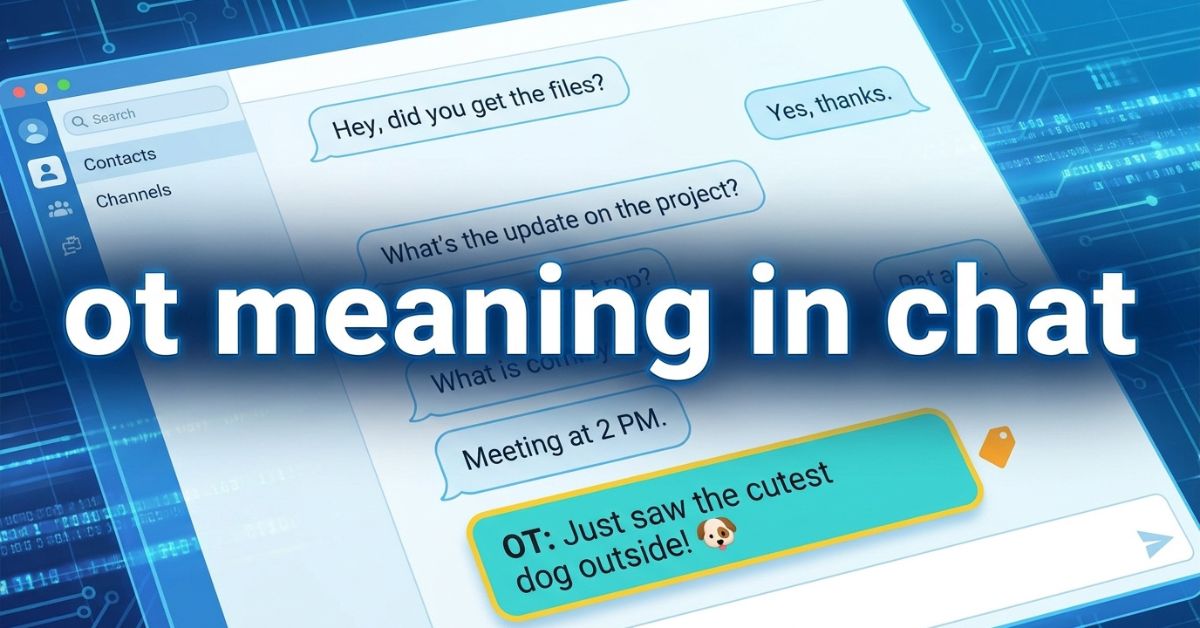
Have you ever opened a text, seen OT, and thought, Wait, what does that mean? You’re not alone. These two little letters can mean very different things depending on the conversation. In a casual chat, OT often means off topic. At work, it usually means overtime. You may also see it used for out of town or going OT in certain slang communities. One abbreviation can point to several completely different ideas.
The good news is that the ot meaning in chat is usually easy to figure out once you check the context. Look at the words around OT, the platform, and the person using it. A Discord user may mean something different from a coworker. K-pop fans can also use OT with numbers to show support for group members. So, before guessing, read the whole message. The answer is often hiding right there.
Why This Term Confuses People
The ot meaning in chat can feel confusing because these two letters have several meanings. Most often, OT means off topic in text slang. However, it can also mean overtime or out of town.
Context clues usually reveal the right meaning. For example, a nurse may use OT when talking about an overtime shift. A Discord user may use it when changing the subject.
- Off topic = changing the subject
- Overtime = extra work hours
- Out of town = going somewhere away from home
Conversation example:
Alex: OT, did you finish the movie?
Sam: Not yet. Why?
Here, OT means off topic. The ot meaning in chat can change with the conversation.
Age can matter too. Gen Z may know several meanings. Someone from Gen X may only know workplace shorthand.
Breaking Down What OT Actually Means
To understand the ot meaning in chat, start with the most common use: off topic. People use it before sharing something unrelated to the current discussion.
At work, OT usually means overtime. Healthcare workers, nurses, and people in manual labor jobs often use it as quick workplace shorthand.
In some street slang, going OT can mean going out of town. This meaning appears in music culture and some TikTok slang. UK drill music helped spread certain uses online.
K-pop fandoms use OT with numbers too.
- OT7 = support for seven members
- OT8 = support for eight members
- OT9 = support for nine members
- OT13 = support for thirteen members
Example:
Friend: OT, can I ask something random?
You: Sure. What’s up?
Always check the setting before choosing a meaning.
Tone Shifts Everything Here
Words can change meaning when the tone changes. Text messages don’t give you a voice or facial expression. That makes tone in text messaging especially important.
Emoji usage can also offer useful clues. A laughing emoji may make a message playful. A tired face may show frustration about an overtime shift.
Conversation examples:
Coworker: Doing OT again 😭
This likely means extra work feels exhausting.
Coworker: Doing OT again 💰
Now the person may feel happy about earning more money.
Sarcasm in text can create another layer. Someone might say OT before an obviously unrelated comment just to be funny.
Relationship matters too. A friend can use casual chat slang freely. A manager may expect clearer language.
When you’re unsure, look at the surrounding words. The topic, emojis, platform, and relationship all provide helpful context clues.
Skip Using OT in These Situations
Knowing the ot meaning in chat doesn’t mean you should use OT everywhere. Some settings need clearer language.
Professional communication usually rewards simple and direct wording. That’s especially true when following professional email etiquette.
Avoid OT in:
- Job applications
- School essays
- Formal reports
- Important business emails
- Serious personal conversations
- Messages to people unfamiliar with internet slang
For example, don’t write, “OT, can we discuss the deadline?” in a formal email. Instead, write, “On a separate note, can we discuss the deadline?”
Work chats can be different. Slack and Teams often allow casual workplace shorthand when the team already uses it.
Conversation example:
Student: OT, I forgot the assignment.
Teacher: Please send your question clearly.
In formal settings, clarity beats cleverness. When there’s any doubt, spell the phrase out.
Say It Different Ways
Sometimes another phrase sounds more natural than OT. The best choice depends on your audience and the situation.
For casual chats, try these alternatives:
- “Random but…”
- “Side note…”
- “Wait, this is unrelated…”
- “Switching gears…”
For polite group chat etiquette, you could write:
- “On a different note…”
- “Changing the subject for a second…”
- “Separately…”
These phrases make your meaning clear without relying on internet slang.
Conversation example:
You: Random but, did you see Sarah yesterday?
Friend: No. Why?
In a work message, “Separately, I wanted to ask about Friday” sounds more polished.
The ot meaning in chat works well among people who understand it. Still, alternative phrases can prevent confusion. They also help bridge a generational language gap between Gen Z and older readers.
Clear words don’t have to sound boring. Sometimes, the simplest phrase works best.
Read More: What Does KMS Mean in Text ? The Truth Behind Those 3 Letters
How It Looks in Real Messages
The ot meaning in chat becomes easier when you see it inside real messages. The surrounding words usually reveal what OT means.
For example, someone might use OT before changing the subject. At work, the same letters usually refer to overtime.
Conversation examples:
Mia: OT, did you watch that new show?
Jake: Not yet. Is it good?
Here, OT means off topic. The speaker wants to ask something unrelated.
Coworker: I’m doing OT on Saturday.
Sam: That’s rough. Hope you get some rest.
Here, OT means overtime.
You may also see going OT in street slang or music-related posts.
- “OT, where did you buy that?”
- “I picked up an OT shift.”
- “They’re going OT tonight.”
- “OT7 forever!”
The last example belongs to K-pop fandom language. OT7 means supporting the original seven group members.
Always check the topic before guessing the ot meaning in chat.
Each Platform Uses It Differently
The ot meaning in chat can shift depending on the platform. Different online communities develop their own habits and slang.
On Discord, Reddit, and older forums, OT often means off topic. Users may add it before a question that doesn’t match the current discussion.
Example:
User: OT, has anyone tried the new update?
Reply: Yeah, it works better now.
On Slack and Teams, OT usually means overtime when coworkers discuss schedules.
TikTok, Instagram, Snapchat, and Twitter can mix several meanings. Context becomes especially important there.
- Discord: Off topic
- Reddit/forums: Off topic
- Slack/Teams: Overtime
- TikTok: Several slang meanings
- Instagram: Context-dependent
- Snapchat: Often casual shorthand
- Twitter: Fandom and internet slang
K-pop Twitter and fan communities also use OT7, OT8, OT9, or OT13. These terms describe fan loyalty toward specific group members.
Because each platform has its own culture, don’t assume every OT means the same thing.
Common Mix-Ups Explained
Several common mistakes make the ot meaning in chat harder to understand. The biggest problem happens when people recognize the letters but ignore the surrounding context.
For instance, a coworker saying “I need OT” probably means overtime. A Reddit user writing “OT, quick question” likely means off topic.
Numbers can cause another mix-up. In K-pop fandoms, OT7 or OT9 usually describes support for an original lineup or specific group members.
- OT before a question → often off topic
- OT with work hours → usually overtime
- Going OT → may mean out of town
- OT plus a number → often fandom language
- Street slang → check the wider context
Conversation example:
Alex: I’m going OT tonight.
Ben: Do you mean overtime?
That simple question can prevent a misunderstanding.
Emoji usage can help too, but emojis don’t guarantee a meaning. When you’re unsure, look at the whole message instead of focusing on two letters.
The ot meaning in chat depends on context, platform, audience, and conversation topic.
Questions People Keep Asking About Term “OT”
Is it rude to use OT in group chats?
The ot meaning in chat usually signals an unrelated topic and isn’t rude when used politely.
However, repeated off-topic messages can annoy others and disrupt the group chat.
Can OT be sarcastic?
Yes, the ot meaning in chat can appear in sarcastic messages when someone jokingly changes topics.
Tone, emojis, and context clues usually reveal whether the message sounds playful or serious.
Does it mean the same thing everywhere?
No, the ot meaning in chat changes with context, platform, and audience.
It can mean off topic, overtime, or out of town in different conversations.
What if someone uses OT and a number but it’s not K-pop?
The ot meaning in chat with a number may describe a team, lineup, or group.
Check the conversation first because numbers can have different meanings outside K-pop fandoms.
Should I use it at work?
The ot meaning in chat can mean overtime at work, especially when discussing schedules or extra hours.
For off-topic comments, clearer phrases work better in professional email etiquette and formal messages.
What does it mean when a girl texts OT?
The ot meaning in chat doesn’t change based on gender and usually depends on context.
Check the surrounding message to understand whether she means off topic, overtime, or something else.
Final Thoughts
Understanding ot meaning in chat becomes simple when you check the context. The phrase ot meaning in chat can point to different ideas. Most often, OT means off topic in casual conversations. At work, ot meaning in chat may refer to overtime. In some slang, OT can mean out of town or going OT. K-pop fans may also use OT with numbers to show support for members.
The best way to understand ot meaning in chat is to read the full message. Look at the words before and after OT. Think about the platform too. A Discord chat may use OT differently than a work message. Your ot meaning in chat guess should always match the situation. When you are unsure, ask the sender what they mean. This avoids confusion. It also makes conversations easier. Now, ot meaning in chat should feel much clearer and easier to understand.
